Narrative
Introduction
For this project, we analyzed Twitch performance and engagement analytics from twitchtracker.com, a website detailing real-time data regarding streamer rankings across the globe. These rankings, consisting of the top 1000 Twitch streamers, are formulated using an aggregate of followers, views, streaming time and returning viewers to provide a hierarchy for Twitch’s top creators. We used these engagement-based rankings as a metric to define who is most successful on the platform, and from there looked for correlations between measurements of success (such as average number of viewers or followers gained per stream) and independent factors (such as streaming genre selected, language spoken, etc). In comparing these variables, we comprehensively examined patterns in Twitch’s top creators to discern what separates them from the rest.
Overview
Our literature compilation paints a picture that covers the periphery of our dataset, providing insights on streamers, viewers, and the increasingly complex dynamics between the two groups as a new form of “broadcasted play” emerges. Many scholars have taken an interest in this emerging medium, going as far as calling it a new frontier in converging entertainment (Johnson). For instance, new models for celebrities and entertainment production labeled “microstreamers” and “home studios” begin to take shape. Furthermore, many creatives in the industry now must navigate new spaces in organizing oneself as a “one-man-show,” incorporating brand, authenticity, and content creation on top of regular viewer interaction.
For this project, we analyzed Twitch performance and engagement analytics from twitchtracker.com, a website detailing real-time data regarding streamer rankings across the globe. These rankings, consisting of the top 1000 Twitch streamers, are formulated using an aggregate of followers, views, streaming time and returning viewers to provide a hierarchy for Twitch’s top creators. We used these engagement-based rankings as a metric to define who is most successful on the platform, and from there looked for correlations between measurements of success (such as average number of viewers or followers gained per stream) and independent factors (such as streaming genre selected, language spoken, etc). In comparing these variables, we comprehensively examined patterns in Twitch’s top creators to discern what separates them from the rest.
However, despite the excitement surrounding this new field for potential study, some scholars have noted the pitfalls that emerge in the ostensibly welcoming platform of Twitch. For one, Twitch is consistently recognized as diverse in content and viewership, yet many observe systemic biases that marginalize women and creators of color as they attempt to break into the space. Likewise, the newly observed phenomenon of parasocial relationships remains an ambiguous can of worms in terms of its implications.
Most scholars seem to agree that Twitch is about way more than just gameplay. It’s really a space for community, emotional connection, and identity building. Whether it’s through real-time chat, shared humor, or even just the presence of a familiar streamer, people turn to Twitch for a sense of belonging. There’s also the idea that streamers aren’t just content creators, they’re emotional anchors for their viewers. There’s been a lot of focus on why Twitch attracts viewers, but less clarity around what makes a streamer into a top performer on the platform. For example, is it really about streaming more hours, or is that just a fast track to burnout in both the viewers and the streamer? Does the algorithm get boosted for drama, or does it just appear to do so? And what about language? Are English-speaking streamers more visible because of how the system is built? Scholars have begun to explore these ideas, but there is still much we don’t know, especially regarding how Twitch’s algorithm handles different identities, strategies, or platforms. Our project is trying to fill in those gaps by looking at actual data from the top 1000 streamers and asking: Is there a real pattern behind who gets seen, who grows, and who gets left behind?
History and Timeline
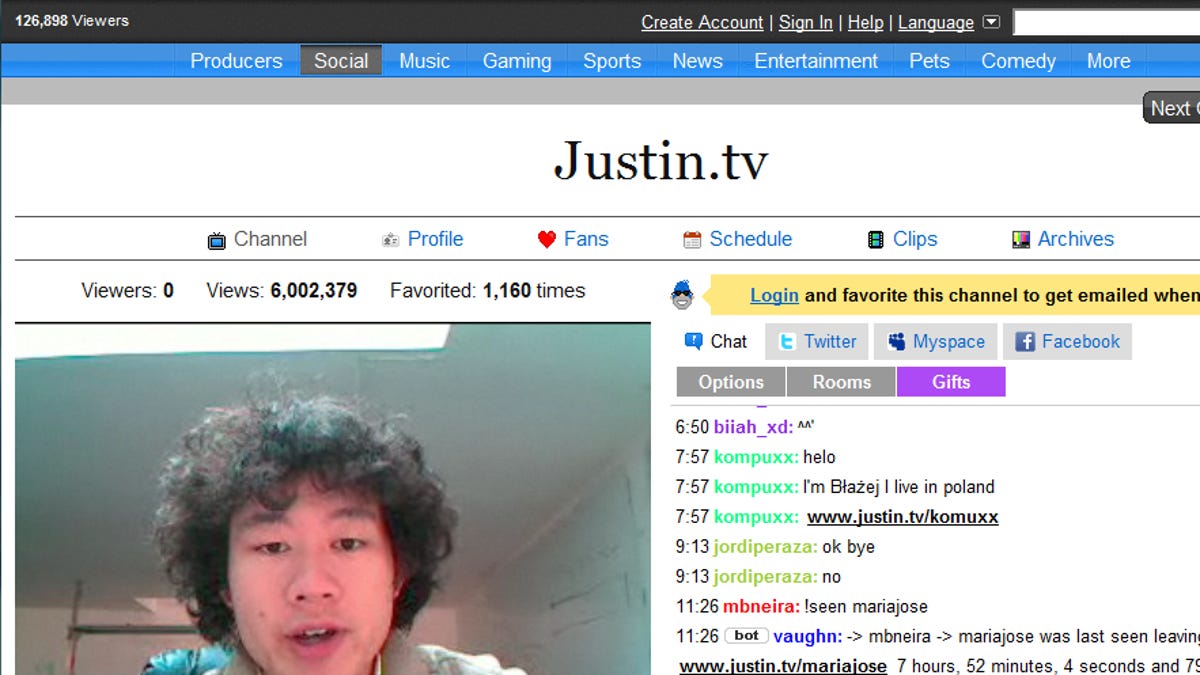
Livestreaming, as the convergence of past media, communication, and entertainment, has a history paving its current form on the internet today. Early on, media scholars have observed the attempts and ideation of “interactive flexibility” incorporated into early television shows, particularly in children’s media (Taylor, 27). While this seems like an unconventional starting point for the platform of Twitch we know today, the intersection of the appeal of television with the social-oriented online communities of the early internet was a compelling concept to explore in its infancy. T. L. Taylor, author of Watch Me Play: Twitch and the Rise of Game Live Streaming, explores the interpersonal connections that emerge from phenomenons like early webcamming. She notes that the sense of presence between two individuals, despite being only united by a screen, is a “powerful hook in our shared network experiences.” With accompanying technological evolutions in mind, the foundation for online-mediated communication was born, and a certain Justin Kan decided to take it to the next level.
Justin Kan and his team created Justin.tv, an early experimental website with the goal of introducing “lifecasting”, a form of entertainment by which someone would essentially stream their day-to-day life for twenty-four hours a day, seven days a week (Johnson, 25). Justin Kan volunteered as the site’s first “reality star,” giving what media scholar Mark R. Johnson refers to as a “strikingly intimate portrayal of his life at the time.” These streams formed the basis for the streamer-viewer dynamics and interactions seen today (Johnson, 89). The intimacy of a livestream was starting to reveal itself, but this dynamic became noticeably popular in Justin.tv’s gaming sector (Johnson, 26). To make a long story short, the growth of Justin.tv’s gaming categories spawned Twitch in 2011, a similar streaming site made to specialize in gaming content. While not to the intimate level of “livecasting,” Twitch cultivated an environment where aspiring content creators could broadcast their play and integrate their audience into the experience (Taylor, 69). Justin.tv was eventually shut down so that Justin’s company could allocate more resources to Twitch. Twitch was ultimately acquired by Amazon, and consequent events made Twitch into the platform it is today, harboring creativity that expands far beyond gaming content. To some extent, Twitch became the platform that Justin.tv was intended to be. For more specifics, please peruse the timeline below.
To be explicit, this segment is meant to set the stage for the following discussions regarding Twitch’s ecosystem and the interactions that take place. Gaining insights into these interactions is integral to defining Twitch’s framework(s) for success as they provide perspectives on those who utilize the platform. With our dataset in mind, we explored a few select case studies to supplement our knowledge in making conclusions. In the end, we found the scope of our questions a bit difficult to narrow given the limitations of our dataset. Regardless, the following findings reflect our goal to define the constraints of Twitch success while juxtaposing them with the experiences and visibility of less-represented groups on the platform.

Findings from Literature
How women broke into the sphere
When gaming first began to gain popularity around the 1980s, it was originally seen as a masculine space and hobby. Even though women participated in developing computer technology, they received less recognition as computers became globalized standard technology. As more women began to break into gaming specifically, they faced clear sexism for their involvement in the industry. The article, “Streaming out of the Spiral of Silence. Women’s Visibility in Gaming Community and on Twitch,” discusses how women were met with hostility, heightened competitiveness, and negativity. They reported cases of men being angry and aggressive if they lost, insulting their skills, or otherwise being unencouraging to get them off the game. Thus, many women avoided the gaming sphere.
Around the 2010s when gaming became mainstream and 2011 when Twitch was established, women were seen as “fake gamers,” or “posers,” those who faked interest in gaming to gain attention. In other words, they were seen as invading the community that was thought to be a safe space for men only (Carradore). In response, some women initiated programs meant to publicize women’s discrimination and misogyny through video essays (such as Anita Sarkeesian) or discussions, aiming to carve a supportive community for women and publicize the issue.
It came to a head in 2014 during a scandal known as #GamerGate. Eron Gjoni published a blog documenting sexual infidelity by his ex-girlfriend, Zoe Quinn, author of “Depression Quest,” accusing Quinn of “[exchanging] sexual favours for positive coverage of her game with journalist Nathan Grayson” (Carradore). Although the accusations were false, supporters of GamerGate claimed to be outraged by how news outlets were not covering a case of unethical actions. However, the publicization of GamerGate brought to light how videogames needed to grow more inclusive, and did not need to be a strictly masculine sphere.
With the popularity of Twitch in the present time, more women than ever have been able to grow communities around gaming and personality then before. In spite of that, they still face opposition by peers and audiences. A glaring example is the viewpoint that women use their bodies and sexual attractiveness to garner audiences and donations on Twitch, therefore not being “real streamers or gamers,” but instead cheating the system unfairly and stealing viewers. It goes to show that success on Twitch doesn’t depend on just playing games for others to watch. Marginalized groups can face unique barriers even within the Twitch community, and all streamers need effective methods to protect themselves online while still creating an engaging experience for their viewers. Making yourself known to hundreds or thousands of people who can stay anonymous over the internet presents its own challenges, but women and marginalized groups have found more supportive communities for themselves and their issues than ever before.
Marginalization of Black gamers on Twitch
Twitch is understood as a platform promoting “cultural production”, as described in chapter 22 of Digital Sociologies by Kishonna L. Gray. A site in which nonprofessional users predominantly generate content as both players and commentators on existing games, the environment on Twitch encourages an audience that actively engages with its content instead of passively consuming it. This environment, which gives its audience such license, works to provide independence both for the Twitch creator and the audience member while also contributing to the economic success of Twitch as a corporation. However, this sense of empowerment has also led to mockery, ridicule and social discordance among audience members against marginalized creators on Twitch, specifically against its Black creators. The chapter examines racially-charged harassment on Twitch against Black streamers by evaluating the comments posted in a public gaming forum. These comments revealed the narratives at play relegating Black creators to the sidelines of gaming and streaming culture, as well as foreshadowed the future of racial discrimination on Twitch.
Before understanding the implications that these comments revealed, it is important to know how communication operates on a digital platform. While in public in-person spaces between an individual and several people host a level of discretion in order to maintain social balance, exchange of thought in private spaces, such as between two individuals or one’s own thoughts, substantially eliminates discretion. With the development of the digital space, communication by a user through a digital device facilitates the comfort of private communication, especially with its ease of anonymity. Virtual environments amplify a sense of entitlement in users to share the thoughts that otherwise would be kept to themselves, and thus exacerbates the social systems which marginalize those who deviate from the norm. Gray includes Black cyberfeminist thought as a lens to view this research under. Although the study highlights the discrimination of Black male creators in particular, it is worth noting how the intersection of identities in Black female creators often means marginalization in a way distinctive to their experience of the platform and separate from their male counterparts. In the same way, while Black male creators may socially benefit from their masculinity in public spaces, it is their race which undermines their masculine advantage as compared to white male creators in virtual platforms like Twitch.
One quote examined from the forum, in reference to the behavior of Black creators on Twitch, claims that “They’re just too urban. I mean, if they would just be more normal, like regular gamers, then they could probably get more followers.” The use of “urban” in this context brings to light awareness of class differences and structural racism, often perpetuated in political contexts like gentrification. One creator noted, “They showed the black dude from The Walking Zed and everyone started dropping the N-bomb and asking, ‘Lucian is that you?!’” In reference to Black creators opposing this harassment, another commenter wrote “But no one wants to hear all that. We can’t relate,” and “What do you expect when the majority of the player base seems to be white people?” By enforcing the idea that such harassment is to be expected on the platform, it propels audiences to speak freely and without regard to the real discrimination they sustain. In response to the suggestion of racism on Twitch, one user stated that “95% of popular Twitch.tv chats are filled with memes, mindless drivel, and oftentimes offensive messages. It’s just part of the culture. It’s not meant to be taken seriously. Anonymous people acting like idiots. It’s been around forever.” Normalization of this behavior as “part of the culture” and recategorizing it as “mindless drivel” gives audiences greater permission to share often inflammatory statements on Twitch without it being viewed as reprehensible, although in public nonvirtual contexts this behavior would be chastised. The exacerbation of systemic racial hierarchy on virtual platforms like Twitch proves to currently be at the disadvantage for its Black creators, but their continued visibility on the platform, however small, may provide hope in increasing the invitation and acceptance of Black creators as the model for popular Twitch streamers.

Importance
In order to help people understand how Twitch’s algorithm and community structures impact who reaches the top, we looked at the top streamers on the site to determine if exposure on the platform represents genuine diversity or enforces a limited blueprint for success. Less focus has been placed on how platform-level factors affect who truly performs the best, despite previous studies emphasizing Twitch’s emotional and social impact, stressing parasocial interactions, viewer loyalty, and community formation. Researchers point out that although live streaming platforms seem democratic, they are governed by systemic disparities related to labor, visibility, and revenue. By incorporating engagement metrics (follower growth, stream length, game tags, and spoken language) with an in-depth examination of which characteristics are overrepresented among the most well-known creators, our study directly addresses this gap.
In taking apart the sizable, current dataset of the top 1000 streamers on Twitch, we demonstrate how success patterns are far less random than is generally assumed. By pointing out that, despite Twitch’s seeming accessibility, its results are filtered by algorithms and attention economy that frequently favor familiarity over exploration and uniformity over variation, this study changes our view of success. In addition to how certain streaming styles may perform better on Twitch, individual characteristics about the streamer themselves may also play a role in determining success. We also briefly analyzed statistics on a streamer’s main language, gender, and preferred game genre. Since Twitch is a largely English-based streaming platform, it makes sense that English-speaking streamers will be significantly more popular for an English-speaking audience than other languages, who may have their own platforms. Gender does not have a direct effect on success, but women or marginalized groups may face greater barriers or difficulties from societal expectations in a gaming community. These factors, in addition to previously studied factors like emotional impact, engagement metrics, and Twitch algorithms, all play a role in determining success on Twitch. Overall, it may not be that anyone who wants to stream can find success, but over time, we find increasing diversity in a formerly male-dominated field of gaming.
Visualizations
The following page explores visual data insights into Twitch streaming, including where top streamers originate, the languages they broadcast in, and which content categories attract the most viewers and followers. Through maps and charts, we reveal patterns that shape success and audience trends on the platform.
Top 100 Twitch streamers by their country of origin

This choropleth world map displays the global distribution of the top 100 Twitch streamers, indicating their geographical origins. The color gradient indicates the number of top streamers per nation, with darker or brighter colors signifying a higher presence. The map helps viewers immediately recognize regional disparities in streamer visibility and platform dominance. The United States leads with 35 streamers, followed by a mix of streamers from Europe, Latin America, and Asia. What stands out is how concentrated these top creators are in regions that already have strong digital infrastructure and established gaming cultures. This map helps illustrate that, despite Twitch being a global platform, its most successful creators tend to originate from specific regions. It suggests that geography still plays a big role in visibility and success on Twitch. A person’s chance of being seen can increase if they stream from a country with better online access, a larger existing audience, and stronger ties to the Twitch community.
How do the followers a streamer gains during a stream relate to various Twitch streamers’ language demographics?

This graph compares the average number of followers gained per stream across different languages among the top 1000 Twitch streamers. Hungarian-speaking streamers top the list with the highest average, followed by Spanish and Polish. At the lower end, streamers who speak Chinese, Czech, and Korean tend to gain fewer followers per stream. This shows that not all languages are treated equally when it comes to audience growth. Some language communities are more engaged or more discoverable than others. This difference could be based on several factors, such as algorithmic bias, cultural streaming habits, or the frequency at which users search for creators in those languages. Either way, the graph indicates that language choice can significantly impact how quickly a streamer gains new followers.
Viewer Engagement and Follower Growth Across Twitch Streaming Categories

This chart breaks down the average number of viewers and followers per stream across various content categories. NBA 2K22 stands out with the highest average viewership and also leads in average followers gained per stream, meaning viewers of that category are more likely to follow the streamer. Other games, such as Special Events and FIFA 21, also draw large audiences, but those viewers are not always turning into followers at the same rate. This chart is important because it shows that high views do not always lead to strong engagement. In other words, some categories are suitable for exposure, while others are more effective for building community and loyalty. Understanding this helps explain why certain creators might focus on specific content even if the audience size is smaller.
How do Language and Location Shape Visibility on Twitch?

This map illustrates the global distribution of Twitch users in 2021, showing which countries have the largest percentages of the total user base. The United States accounts for over 36 percent of all Twitch users, followed by countries such as Brazil, Germany, Russia, and South Korea. This suggests that location affects not only access to Twitch but also a streamer’s chances of being discovered. Countries with larger Twitch audiences naturally offer better visibility and discoverability for creators within those regions. It also means that streamers based in areas with smaller user bases may have to work harder to be discovered or rely more on their global reach. The map highlights how internet infrastructure, regional interest in gaming, and proximity to Twitch’s core audience can all influence a streamer’s potential growth. Language and geography are deeply connected here, since countries with large Twitch populations tend to align with the platform’s most visible languages, reinforcing which creators rise to the top.

This bar graph compares total follower counts by the main language used by streamers. English dominates by a large margin, followed by Spanish and French. Although languages like Korean, Japanese, and Arabic are spoken by millions globally, they fall far behind in the total number of followers. This chart clearly shows that English is the default language on Twitch, which can make it harder for creators in other languages to gain widespread recognition. The gap here is not just about language fluency. It reflects deeper issues related to global digital inequality, platform bias, and who the Twitch algorithm pushes to the top. For viewers, this means their recommended content is more likely to be in English. For streamers, using English or appealing to English-speaking audiences may be necessary to grow.

This bubble chart represents the total views each language category receives on Twitch. The size of the bubble corresponds to total viewership, and once again, English takes up the largest space by far. Spanish, Portuguese, and Russian follow, while other languages are significantly smaller. What this visual shows is not just which languages are most used, but which ones are most watched. Even if smaller language groups are active on Twitch, they may not be getting the same level of attention. The design of the chart also helps directly highlight the imbalance between languages. While Twitch operates globally, the platform’s actual traffic and attention are centered on a few dominant languages. This reinforces the idea that language is not a neutral factor. It plays a significant role in who gets noticed, who gains followers, and who remains small.
Conclusions
After analyzing the top 1000 streamers on Twitch, it becomes clear that success on the platform is not as spontaneous or open-ended as it may seem. While Twitch presents itself as a space where anyone can start streaming and grow a community, our data and findings show that success follows certain patterns. Top creators are not just playing games. They are consistently putting in long hours, promoting themselves on other platforms like YouTube or TikTok, and participating in large events or collaborations. These are the behaviors that tend to be rewarded by Twitch’s algorithm and visibility systems. As a result, the creators who rise to the top often share similar habits, strategies, and even backgrounds.
Looking at gender representation in streaming, it is clear that while more women are visible in the space today, their presence is still shaped by longstanding stereotypes. From being labeled as fake gamers to facing ongoing harassment, female streamers continue to navigate harmful assumptions. They are often criticized for gaining success through their appearance or personality rather than their skill, which makes it harder for their achievements to be recognized as valid. Even now, the Twitch community can be quick to question the legitimacy of female creator success. This shows how old biases continue to influence perceptions, even on platforms that are often seen as new and open.
Language also plays a big role in how visible a streamer becomes. The majority of top Twitch creators speak English or Spanish, which reflects the dominance of those languages globally. But it also means that streamers from other language backgrounds face more challenges when it comes to building a large following. Content in less common languages tends to receive less algorithmic support, which makes it harder for those creators to gain traction. The structure of the platform unintentionally favors those who already align with global or Western norms, which contributes to an uneven playing field on the platform.
The dataset we used helped us identify trends in engagement and performance, but it also is limited in certain areas. It focuses on numbers, such as average viewers, followers, and stream time, but it does not show us the relationships built between streamers and their audiences. There is no data on emotional connection, loyalty, or the way communities form and support one another over time. The top 1000 streamers make up a small percentage of Twitch overall, and by focusing only on them, we risk ignoring the creators who are doing meaningful work outside of the spotlight. Smaller streamers, especially those from marginalized groups, are still contributing to the platform’s culture, even if they are not yet reflected in the rankings.
At the same time, our data visualizations suggest that things are beginning to shift. The global map and genre breakdowns on our website show that Twitch is gradually becoming more varied in terms of who is streaming, where they are from, and what kind of content they are producing. While the most popular creators still tend to look and sound similar, there is an increasing number of streamers building engaged, loyal audiences around niche interests or specific communities. Some streamers are successful not because they have the most followers, but because they provide something unique, such as a space to belong, a shared language, or a style of interaction that feels personal.
So, is Twitch truly diverse? The answer is complicated. It is more diverse than it was in the past, and more people from different regions, genders, and identities are gaining visibility. But the platform still has a long way to go in terms of equity. Visibility is not the same as support. Just being able to stream does not mean all creators are given the same chance to grow. Success still depends on navigating a system that rewards constant content, favors English and Spanish speakers, and often overlooks the structural challenges faced by marginalized users.
What comes next depends on how Twitch chooses to evolve. The platform has the potential to create a more inclusive environment, but that will require rethinking how success is defined and what kinds of creators get promoted. It also means recognizing the value of smaller communities, emotional labor, and creative experimentation. Diversity is not just about numbers or categories. It is about making space for difference, supporting creators who break the mold, and changing the system so that more people feel like they truly belong.
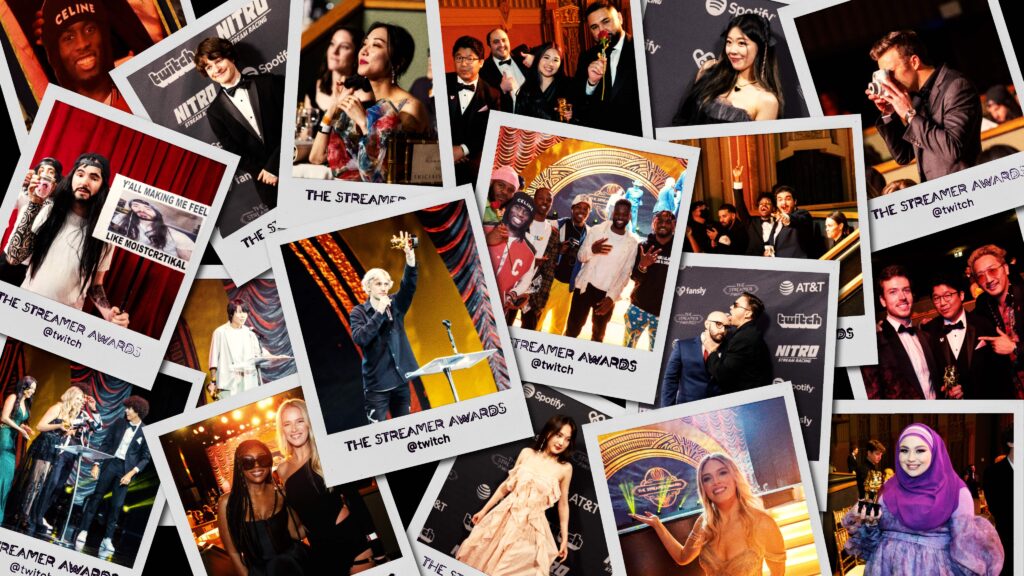
The Streamer Awards on Twitch, 2023
Twitch is not there yet. But it could be. And the patterns we see now can help shape the changes necessary for Twitch to support the success of creators of all backgrounds.